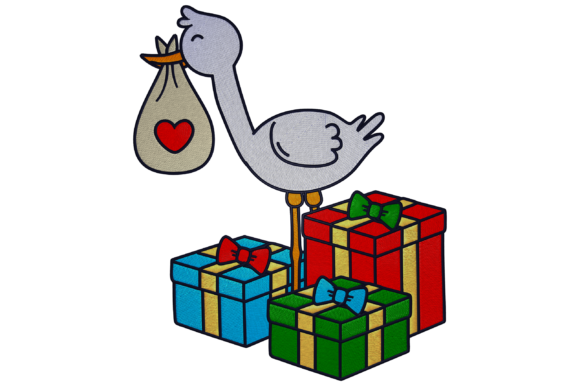
Stork Bringing Gifts
A Designer’s First Look: Sweet, Simple, and Ready for Real Projects
When I opened Stork Bringing Gifts for the first time, I didn’t see just another baby-themed machine embroidery design—I saw a small but meaningful moment captured in thread. It’s warm without being cloying, playful without sacrificing clarity, and detailed enough to feel intentional—but not so intricate that it risks stitching failure on everyday fabrics. As someone who’s stitched hundreds of baby embroidery files for clients, Etsy listings, and boutique merchandise, I immediately pictured it on a soft organic cotton romper, centered neatly above the pocket. That’s where it lives best: as a quiet focal point, not a busy backdrop.
Where This Design Earns Its Keep—In Real Life
Last week, I used Stork Bringing Gifts on a custom embroidered tote bag for a local baby boutique. The client wanted something gentle but distinctive—no cliché onesies or overused “It’s a Boy/Girl” banners. We chose a natural linen-cotton blend tote, medium-weight, with light stabilizer. The result? Clean satin stitch on the stork’s body, smooth fill stitch in the gift bundle, and just enough running stitch detail in the wings to suggest motion—not clutter. Customers paused at the display rack. Not because it shouted, but because it felt *considered*. That’s the quiet strength of this design: it supports the handmade product without competing with it.
It performs especially well on sweatshirt embroidery and baby apparel—think onesies, burp cloths, and pillow covers—where simplicity reads as premium. On a structured cotton apron for a maternity photographer’s gift set? Perfect. On a tea towel for a baby shower favor? Equally at home. Even as an embroidered patch (heat-applied or sewn), the proportions hold up. The stork’s posture—slightly tilted, wing extended—creates visual rhythm without demanding perfect centering. That flexibility matters when you’re stitching across curved surfaces like caps or uneven seams on rompers.
Where to Pause—and Test First
That said, Stork Bringing Gifts isn’t bulletproof everywhere. On thin or stretchy fabric—like jersey knits or lightweight rayon blends—it needs extra stabilization. I’ve seen the gift bundle’s fill stitch pull slightly on unstable bases, especially if thread tension isn’t dialed in. And while the design avoids tiny lettering or micro-details, the stork’s beak and eye are small enough that they’ll blur on dark fabric unless you use high-contrast thread or add a light underlay. Always test the embroidery file on scrap fabric first—especially if you’re planning commercial embroidery for a craft business or Etsy seller inventory.
Also worth noting: the shape leans slightly vertical. That makes it ideal for center-chest placements or pillow cover medallions—but less intuitive for wide, low-hooped areas like the back of a toddler sweatshirt unless you adjust placement intentionally. If you’re using it for holiday embroidery (say, a baby’s first Christmas ornament), keep hoop size in mind. It’s not a tiny 2-inch motif—but it’s not a full 5-inch statement either. Check your machine’s recommended hoop range before digitizing or scaling.
Design Notes Every Embroidery Designer Should Keep Handy
- Test on scrap fabric first—especially with textured fabrics like terry cloth or bouclé, where stitch definition can soften.
- Review stitch density before stitching on delicate baby embroidery substrates; dense fills may stiffen lightweight rompers.
- Confirm thread color contrast early—this design shines in muted palettes (dusty blue + cream, sage + oat) but loses charm if thread blends too much with the base fabric.
- Use proper stabilizer: medium cutaway for knits, tear-away for stable wovens. Skip the no-stabilizer experiment—even for “easy” designs like this one.
- Check licensing before selling finished products or listing the digital embroidery file. Not all baby embroidery assets permit commercial use out of the box.
- Try black-and-white mockups before finalizing—Stork Bringing Gifts relies on shape and flow more than color, so grayscale previews reveal how well its silhouette reads.
Why It Builds Trust—Not Just Cuteness
In my experience, customers don’t buy baby embroidery for novelty alone. They buy it for emotional resonance—and for proof that the maker paid attention. Stork Bringing Gifts delivers both. Its balance of whimsy and restraint signals professionalism, not just hobbyist enthusiasm. When I list similar designs as part of my own craft business, items with this kind of thoughtful execution get higher engagement, better reviews (“so much nicer than the generic ones I found elsewhere”), and repeat orders from boutique buyers who curate cohesive nursery decor lines.
It also works quietly for brand consistency. Whether you’re embroidering for a midwife’s gift line, a sustainable baby brand, or a handmade shop with a minimalist aesthetic, Stork Bringing Gifts adapts. It doesn’t scream “baby”—it whispers “care.” That nuance elevates the finished product beyond seasonal trendiness into something timeless enough for heirloom pieces or personalized gifts meant to last.
Final Thought: A Design That Serves the Project—Not the Other Way Around
There’s a difference between a design that looks good on screen and one that earns its place on a real, worn, loved item. Stork Bringing Gifts belongs in the second category. It’s not flashy. It won’t dominate a social media feed—but it will make a new parent pause, smile, and say, “Yes, that’s exactly how I imagined it.” That’s the mark of strong design judgment: knowing when simplicity is strategy, not compromise. If you’re choosing embroidery assets for babies, custom apparel, or small shop products, this one deserves a spot in your working library—not just your inspiration folder.