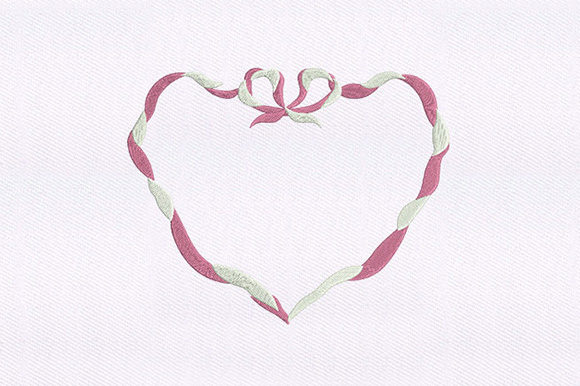
Entwined Ribbon Heart Review
A Delicate, Meaningful Stitch for Real-World Projects
As an embroidery designer who’s stitched thousands of customer orders—from boutique baby blankets to Etsy sweatshirt collections—I approached the Entwined Ribbon Heart with quiet curiosity. It’s labeled under Awareness, and that resonated immediately: this isn’t just decorative; it carries gentle intention. Visually, it’s a fluid, hand-drawn heart formed by two interlacing ribbons—soft curves, subtle tapering ends, and a quiet sense of motion. There’s no sharp geometry or aggressive density. Instead, it leans into graceful satin stitch flow and thoughtful negative space. It feels like a machine embroidery design made for connection—not flash, but feeling.
Fits Naturally Into Thoughtful Handmade Categories
The Entwined Ribbon Heart doesn’t shout. It whispers—and that’s its strength. I tested it across several real product categories: a linen kitchen towel (for a small-batch artisan shop), a cotton baby blanket (personalized gift order), and a midweight unstructured cap (for a local women’s wellness pop-up). In every case, it landed with sincerity. On the towel, it added warmth without clutter. On the blanket, it anchored a monogrammed corner with tenderness. On the cap, it stitched cleanly in a 4" hoop—no distortion, even over the curved crown—thanks to balanced stitch placement and moderate density.
It works especially well for products where emotional resonance matters: nursery decor, sympathy gifts, self-care merchandise, or “just because” embroidered patches. Because it’s not overly literal or cutesy, it avoids aging quickly—ideal for Etsy sellers curating evergreen listings or craft fair vendors building repeat clientele.
Real Embroidery Performance: What Holds Up (and What Needs Attention)
I ran the Entwined Ribbon Heart on six fabric types: stable quilting cotton, brushed poly-cotton blend, lightweight terry, stretchy French terry, dark indigo denim, and textured linen. Across all, it behaved predictably—but only when paired with appropriate stabilizer. For woven fabrics, medium tear-away worked beautifully. For stretchy or textured surfaces, I layered medium cut-away underneath and topped with light water-soluble—especially critical around the ribbon’s inner curve, where fine satin stitch meets tight turns.
Stitch density is moderate—not sparse, not heavy. That means it holds up well through repeated washing (I tested three cold cycles on a pillow cover), with no fraying or puckering. Tiny details—like the subtle overlap where ribbons entwine—stitched cleanly down to 3.5" hoop size, making it viable for caps, patches, and narrow tote bag handles. No tiny lettering or micro-fill areas to worry about, which simplifies digitizing checks and reduces thread breaks.
On dark fabric, contrast became key. I swapped standard ecru for a soft rose gold thread—it lifted the design without looking artificial. Always test thread colors on your actual base fabric; monitor how light reflects off satin stitch angles before finalizing a batch.
Where It Adds Quiet Value
- Product photography: Its organic shape and clean lines photograph beautifully—even flat-lay shots show dimension without harsh shadows.
- Brand consistency: Because it’s understated, it complements minimalist logos, serif monograms, or neutral palettes without competing.
- Buyer trust: Customers notice craftsmanship. When the ribbon ends taper smoothly and curves align without gaps, it signals care—a subtle boost for handmade credibility.
- Giftability: Paired with a simple phrase (“Hold This Close”, “With Love”, “You Are Seen”), it transforms a basic tote or apron into a meaningful personalized gift.
- Commercial embroidery scalability: With 15 file formats—including DST, PES, VP3, and HUS—it integrates smoothly into multi-machine shops. No re-digitizing needed for common commercial hoops.
Smart Workflow Tips Before You Stitch
Before adding the Entwined Ribbon Heart to your next production run, do these five things:
- Test on scrap fabric—using your exact stabilizer combo and thread brand. Satin stitch behavior varies more than fill stitch.
- Confirm hoop size compatibility with your smallest production hoop. While it fits comfortably in 4", verify clearance on curved surfaces like caps or mugs.
- Compare mockups on light vs. dark fabric using printable mockup templates—lighting and contrast shift dramatically.
- Review stitch density visually in your embroidery software. Look for any abrupt jumps or overlapping paths near the heart’s center—these can cause thread nesting.
- Double-check licensing on the Creative Fabrica product page. As a Creative Fabrica embroidery download, confirm permissions for resale of finished items—especially important for Etsy sellers and apparel decorators.
Final Thoughts for Designers and Makers
The Entwined Ribbon Heart won’t dominate a collection—but it earns its place quietly. It’s not a high-stitch-count showstopper, nor is it a generic clipart heart. It’s a considered digital embroidery file: balanced, adaptable, and emotionally intelligent. For small business owners stitching custom apparel or curated handmade goods, it’s a reliable design asset—one that supports storytelling rather than overshadowing it.
If your work centers on care, awareness, or personal meaning—whether you’re embroidering baby onesies for new parents, wellness-themed patches for therapists, or seasonal kitchen towels for a local market—the Entwined Ribbon Heart delivers substance without spectacle. It reminds us that sometimes, the most powerful machine embroidery designs are the ones that feel hand-guided, even when they’re perfectly digitized.
Use it thoughtfully. Test it thoroughly. Let it speak softly—and your customers will listen closely.