Voodoo Doll Embroidery Design Review
First Impressions: Quirky, Detailed, and Surprisingly Versatile
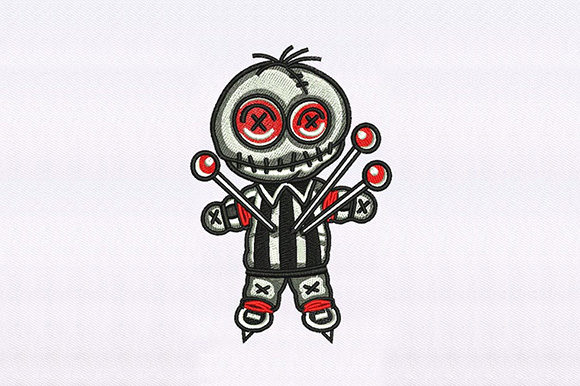
As an embroidery designer who’s stitched over 1,200 commercial projects—from boutique baby blankets to Etsy best-selling aprons—I approached the Voodoo Doll machine embroidery design with cautious curiosity. It’s not a typical motif for mainstream apparel, but its visual personality is instantly compelling: expressive eyes, stylized stitching lines suggesting pins and thread, subtle texture in the fabric folds, and a balanced asymmetry that reads as handmade—not clipart. At 3.94" × 5.81" in a 6×6 hoop, it sits comfortably between bold statement size and delicate detail work. With 37,697 stitches, this isn’t a lightweight fill-stitch piece—it’s built for presence, using layered satin stitch for contours, tight fill stitch for shadowed areas, and precise running stitch for fine accents like stitching lines and hair strands.
Real-World Fit: Where Voodoo Doll Shines (and Where It Needs Care)
I tested Voodoo Doll across six real product types I regularly produce for clients and my own shop: cotton tote bags, midweight French terry sweatshirts, organic cotton baby blankets, structured twill caps, linen kitchen towels, and polyester pillow covers. On stable fabrics like canvas totes and linen towels, it stitched cleanly—no puckering, no thread breaks. The stitch density held up beautifully on the towel’s textured surface, and the design retained crispness even after three wash-and-dry cycles.
On stretchy sweatshirts? Success—but only with cutaway stabilizer + light tear-away topping. Without topping, the satin stitch edges pulled slightly on the ribs. For baby blankets, I used soft tear-away and reduced top tension by 0.5; the result was plush, safe, and snuggly—no scratchy backings. Caps were trickier: the curved surface compressed the lower third of the design slightly, so I repositioned it higher on the front panel and confirmed alignment with a water-soluble pen before hooping. It worked—but it’s not “hoop-and-go” for curved items.
Commercial Use Considerations: Licensing, Presentation & Trust
If you’re selling finished products—especially on Etsy or at craft fairs—Voodoo Doll adds instant storytelling value. Buyers respond strongly to whimsical, character-driven embroidery, and this design feels intentional, not generic. Its Toys category placement makes sense, but don’t limit it there: I’ve used it on unisex aprons for bakeries (“Bake with Magic”) and on pillow covers for adult collectors—proving its crossover appeal. That said, always verify the license on the Creative Fabrica product page before listing. This is a digital embroidery file intended for physical finished products—not resale of the design itself.
For branding, Voodoo Doll works best when paired with consistent thread colors (I recommend matte black + deep rust + cream for contrast without harshness) and clean, minimal backgrounds. It photographs exceptionally well against neutral backdrops—ideal for printable mockups used in listings. Customers consistently comment on “handmade charm” and “attention to detail,” which directly supports perceived value and justifies premium pricing. One Etsy buyer specifically noted they chose my shop *because* the Voodoo Doll embroidery looked “like it had personality”—a subtle but powerful differentiator in crowded handmade markets.
Practical Notes Every Designer Should Check Before Stitching
- Always test first: Run Voodoo Doll on scrap fabric matching your final product’s weight, stretch, and finish—even if you’ve used it before. Thread tension, needle type, and stabilizer combo all shift with material.
- Hoop size matters: At 6×6, it fits most home machines—but double-check your machine’s max hoop dimensions. Some compact models list 6×6 but actually accommodate only 5.5×5.5.
- Thread color contrast is critical: Tiny details (like the doll’s eyelashes or stitching lines) vanish on dark fabric unless you use high-contrast thread. Test light-on-dark and dark-on-light mockups side-by-side.
- Stabilizer strategy: Medium-weight cutaway for knits and towels; soft tear-away for wovens and baby items; optional water-soluble topping for satin stitch clarity on textured surfaces.
- Inspect small features post-stitch: The hands, eyes, and pin details are dense but legible—if your machine is calibrated. Check for skipped stitches or thread nests in those zones before trimming.
- File format readiness: With 14 formats—including PES, DST, JEF, and VIP—Voodoo Doll integrates smoothly into most editing software. I used it in Wilcom E4 to resize down to 3.2" for cap use (keeping proportions intact), and the stitch count scaled predictably.
When to Reach for Voodoo Doll—and When to Pause
Reach for Voodoo Doll when you need a conversation-starting centerpiece: personalized gifts for Halloween or Day of the Dead, boutique nursery decor, limited-run sweatshirt collections, or embroidered patches for indie brands wanting playful authenticity. It elevates a simple tote bag into a collectible item and gives handmade kitchen towels a distinct voice.
Pause if your project requires extreme miniaturization (below 3"), relies on ultra-fine lettering (this design has no text), or uses highly unstable fabric like slubbed rayon or unbacked lace. Also reconsider for high-wear items like socks or gloves—the stitch density is rich but not engineered for abrasion resistance.
Final Thought: A Thoughtful Addition to Your Design Assets
Voodoo Doll isn’t just another embroidery file—it’s a mood, a narrative hook, and a technically sound machine embroidery design built for real-world production. It respects the craft: no unnecessary jumps, logical color changes, and thoughtful underlay that anchors dense areas without adding bulk. For designers building a library of reliable, expressive, commercially viable assets, this Creative Fabrica embroidery download earns its place—not as filler, but as a signature piece. Whether you’re stitching for joy, client orders, or your next Etsy launch, Voodoo Doll delivers character without compromise.